
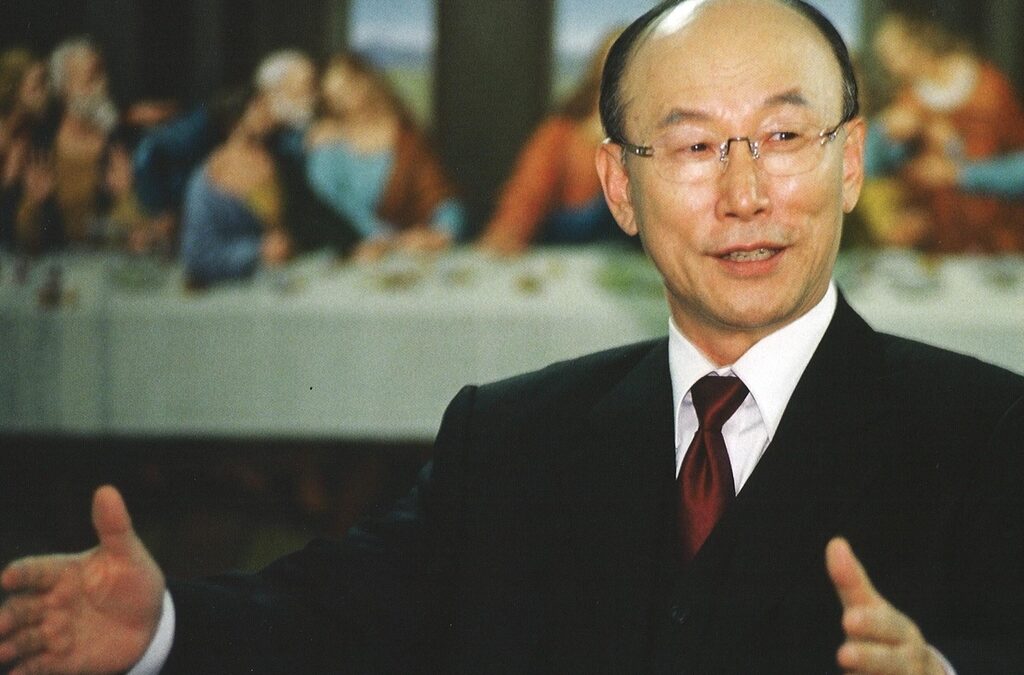
On September 14, 2021, Pastor David Yonggi Cho passed away at the age of 85. As we all know, he planted a church in 1958 with five members in a tent, and over the course of fifty years of ministry—until his retirement in 2008—he grew Yoido Full Gospel Church into the largest church in the world, with a congregation of 800,000 members.
Yet his ministry extended far beyond the walls of the church he founded. Beginning in 1964, when he conducted revival meetings while touring churches across the United States, Pastor Cho went on to lead gospel crusades of unprecedented scale in over 80 countries, traveling a distance equivalent to 120 trips around the globe. Including his ministry through mass media, the number of people who heard the gospel through him is simply beyond calculation.
At the 20th anniversary celebration of Kookmin Daily, attended by Lee Hee-ho, wife of former President Kim Dae-jung, she delivered a congratulatory message on his behalf, saying:
“These days, the Korean Wave is sweeping global culture, but in truth, the original Korean Wave was Pastor David Yonggi Cho. From the 1960s to the present, he has consistently gone out into the world under the single brand name ‘Korea,’ delivering his message in English. Across politics, economics, society, and culture, Pastor Cho is the first—and the only—Korean to do so.”
As the saying goes, the higher the mountain, the deeper the valley. It is rare to find a spiritual leader whose life is surrounded by such dazzling and admirable accolades, yet also marked by controversies—prosperity theology, family-centered leadership, and personal scandals whose full truth may never be known.
However, the purpose of this column is not to evaluate the merits and faults of Pastor Cho’s life and ministry. Rather, its purpose is to analyze the leadership of a man who grew an organization he founded by more than ten thousand times over fifty years.
In the endorsement of the book, CEO Cho Yonggi: Yoido Full Gospel Church Beyond World-Class Corporations, co-authored by professors Kim Sung-kook, Baek Ki-bok, and Choi Yeon, Pastor Dongwon Lee wrote:
“As the CEO who led the world’s largest church organization, studying Pastor Cho’s leadership is both necessary and significant.”
In conclusion, I believe Pastor Cho’s leadership can be analyzed through three key elements: vision, risk-taking, and managerial ability. (What I address here are the human elements of church growth—leadership—not its spiritual factors.)
Vision
The saying that an era produces its heroes is an unchanging truth. Pastor Cho’s early ministry unfolded in post-war Korea, a nation suffering from hunger and disease. As a young man, he contracted tuberculosis—an illness considered incurable at the time—but after a profound spiritual experience, he was healed and entered seminary.
After graduating, he planted a church with a classmate in a slum on the outskirts of Seoul. There, among people living in what seemed like hell due to poverty and sickness, he discovered the message of the age he was called to proclaim:
a message of hope and vision—believing in, dreaming of, and confessing a glorious future despite a desperate present.
This vision enabled him, even amid relentless poverty and recurring illness, to keep a burning passion and hope alive within his inner world. That passion and vision became the driving force that allowed him to overcome a painful present through prayer.
When such qualities fill a leader’s inner life, charisma emerges almost unconsciously. A leader’s charisma often appears as a magnetic pull that draws others to follow.
A church is composed of people from diverse social, economic, and educational backgrounds. It is only natural that such diversity leads to differing dreams and expectations. Yet Pastor Cho possessed an exceptional ability to help people with different dreams begin dreaming the same dream.
One of the powers of vision is its ability to unify people of different dispositions. Pastor Cho’s charismatic leadership ignited in the hearts of his congregation the same vision burning in his own soul. This was not accomplished through instruction. Rather, like a wildfire spreading with the wind, the vision burning in the leader’s soul set fire to the souls of his followers.
The same is true of prayer and evangelism. These cannot be produced merely by teaching principles. The force that moves people to pray and evangelize is not learning, but motivation. Through experiences of grace and the planting of vision, Pastor Cho demonstrated a remarkable ability to motivate people to act.
A leader must be a person of vision. This does not simply mean possessing a vision. A leader must have the ability to plant that vision in the souls of others—to enable people to see a great future that does not yet exist, from the vantage point of the present. That is what vision is, and what vision-casting does.
John Maxwell, in The 2.0 Laws of Leadership, classifies people into four categories based on vision:
-
Those without vision — Wanderers
-
Those with vision who do not pursue it — Followers
-
Those with vision who pursue it — Achievers
-
Those with vision who pursue it and help others pursue it — Leaders
The dynamic power of vision is astonishing. Simply put, vision is the ability to see a better future today. If one cannot see it, one cannot act. If one does not act, one cannot possess it.
Pastor David Yonggi Cho wove together vision, passion, and prayer, and through them exercised extraordinary leadership—not only moving himself to action, but mobilizing all who followed him as well.