
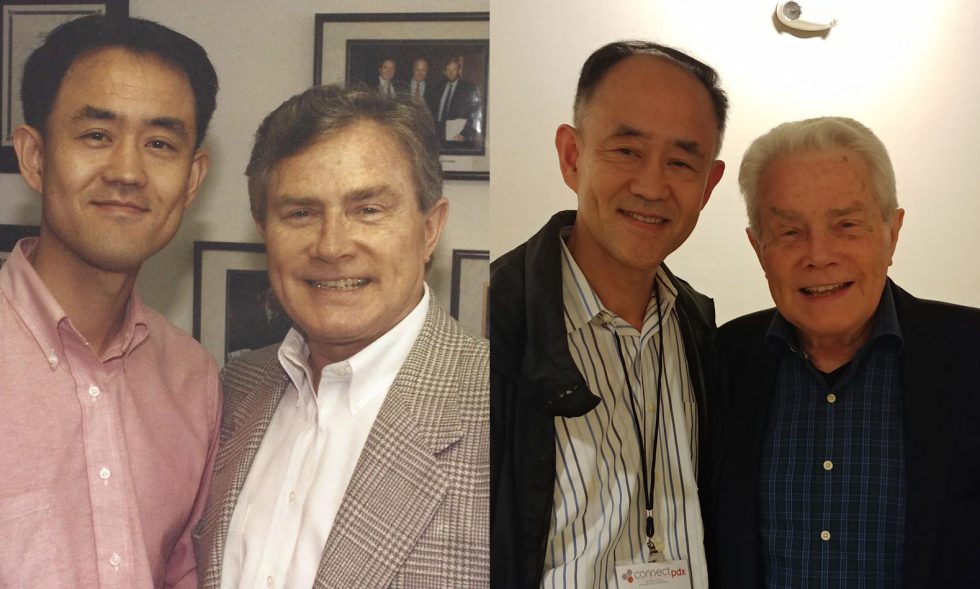
Luis Palau was an evangelist who, together with Billy Graham, shaped the landscape of global evangelism in our time. Born in 1934 in Buenos Aires, Argentina, Luis enjoyed a privileged childhood, studying in English at a British-run boarding school. However, when he lost his father at the age of ten, the family’s financial situation collapsed, and he was forced to become the head of the household, supporting his mother and six younger siblings. Influenced by his father, Luis accepted the gospel at an early age. By the time he was eighteen, listening to Billy Graham’s sermons on the radio had ignited within him a deep passion for the gospel and for winning souls.
In his twenties, a benefactor opened the door for him to study theology in the United States. Though thrilled by the opportunity, Luis struggled to make the decision. The reason was that he had not experienced a dramatic, unmistakable calling from the Lord like the Apostle Paul’s encounter on the road to Damascus. He even considered abandoning the idea of studying abroad. At that moment, his mother offered him remarkable counsel:
“So you’re saying you can’t decide to become a servant of the Lord because you haven’t had a decisive calling experience? Then what do you make of the Lord’s command, ‘Go and make disciples of all nations’? What greater calling do you think you need beyond what Scripture has already made so clear?”
Wikipedia defines mentoring as “guidance or advice provided one-on-one by a trusted person who possesses abundant experience and wisdom.” At its core, mentoring begins with advice. Without his mother’s counsel, Luis Palau—the evangelist often compared to Billy Graham in this century—might never have existed. Through advice, a mentor extends his or her experience and wisdom to the next generation. Through advice, a mentee receives the accumulated wisdom of the previous generation, avoids unnecessary trial and error, and takes firm, wide strides toward achievement.
While receiving theological training in the United States in the early 1960s, Luis married Patricia Scofield, whom he met at school, and together they had four children. In 1962, he served as an intern at Billy Graham’s evangelistic crusade in Fresno, California. There, he was deeply moved by Graham’s simplicity and humility. Throughout the 1960s, Luis interpreted Billy Graham’s sermons throughout Central and South America. Through this close association, he gained inspiration that would define the future direction of his own ministry.
If the foundation of mentoring is advice, then the most powerful way advice is communicated is not through words but through inspiration. Advice is heard with the ears; inspiration is seen with the eyes and felt in the heart. In his teaching on vision, John Maxwell emphasizes this truth: “If you can’t see it, you can’t have it.”
While serving as a missionary in Latin America, Luis Palau was given an opportunity to open the door of the gospel to the world. Billy Graham, his mentor, entrusted him with hundreds of thousands of dollars in funding and assigned two board members from the Billy Graham Evangelistic Association to help him launch the Luis Palau Evangelistic Association. This marked the beginning of the Luis Palau Association, now based in Portland, Oregon (http://www.palau.org).
A responsible mentor goes beyond giving advice and lays a foundation for the mentee’s success. Only then can the mentee truly succeed. The Korean proverb cheongchul-eoram—“blue dye comes from indigo, yet is bluer than indigo”—means that a student surpasses the teacher. This is the mentor’s joy and the mentee’s mission. Nietzsche once said, “A student who does not surpass his teacher dishonors his teacher.” If one cannot rejoice in a mentee surpassing them, one should not engage in mentoring.
In 1973, Billy Graham gathered 1.2 million people on the final day of his Seoul Crusade, creating the largest evangelistic gathering in Christian history at the time. In 1982, Luis Palau gathered 700,000 people in Guatemala City, producing the second-largest gathering in Christian history. Like teacher, like student. (These records have since been surpassed; the current largest gatherings were led by Reinhard Bonnke in Nigeria, who himself has said that he learned how to draw crowds from Billy Graham.)
Immediately after completing the historic Seoul Crusade, Billy Graham’s team flew to Argentina and joined Luis Palau’s team for a united evangelistic campaign in Buenos Aires. Seeing the Graham team arrive fresh from their success in Seoul, an excited Luis said to Cliff Barrows, the team’s worship leader, “Pastor Cliff, let’s ride the momentum from Seoul and preach the gospel powerfully here in Buenos Aires as well.” At that moment, Luis received unforgettable mentoring advice:
“Luis, there is no such thing as ‘momentum’ in the spiritual world. The anointing you received for Seoul ended with the Seoul ministry. We must receive fresh anointing for Buenos Aires.”
Right there in the hotel lobby, they knelt and prayed for a new anointing.
In the 1990s, Muslim populations increased rapidly in the United States and around the world. At the same time, postmodernism fostered a widespread rejection of authority and formal structures. In this environment, traditional evangelistic crusades—with robed choirs, long authoritative sermons, and preachers in black suits—struggled to attract people. Luis Palau responded boldly. He abandoned the term “crusade” and replaced it with “festival.” He reshaped the entire format: family-friendly atmospheres, contemporary music, skateboarding, bicycle and motorcycle stunts, and creative expressions of faith. As a result, his two-day BeachFest in Fort Lauderdale, Florida, in 2001 drew 300,000 people who heard the gospel. After that, even Billy Graham began using the term “festival” instead of “crusade.”
Here, the mentee advised the mentor. Cheongchul-eoram. This is mentoring at its best.
Years ago, a senior pastor once said to me, “We grew like weeds—without ever receiving mentoring from our seniors.” Sadly, that was also my reality. Perhaps the greatest reason Korean pastors struggle with mentoring is that they themselves were never mentored.
After retiring, Billy Graham gave Luis Palau this counsel:
“Luis, my ministry has been a great failure. I preached the gospel to massive crowds around the world, but I failed to raise up successors who could preach on my scale or greater. Do not make the same mistake.”
Taking those words to heart, Luis invited forty next-generation evangelists to his ministry headquarters in Portland in 1998 and formed the Next Generation Alliance (NGA). He mentored them and opened doors for global ministry. I was one of those participants. Through Luis, the door opened for me to hold an evangelistic campaign in Rwanda, Africa. From there, my ministry—first rooted in Eastern Europe—expanded into Africa and Asia, focusing on evangelism and leadership development.
Over the past fifty years, Luis Palau personally preached the gospel to 300 million people in 80 countries. Through 1,780 radio stations in 48 countries, he proclaimed the gospel in English and Spanish to billions more. His next-generation mentoring initiative, NGA, continued to grow and was renamed the Global Network of Evangelists (GNE) two years ago. Today, it mentors more than 800 emerging evangelists worldwide, far beyond the borders of the United States. Through their ministries, the reach of Luis Palau’s evangelistic legacy has expanded beyond measure.
Even while living with stage-four lung cancer for the past three years, Luis Palau continued his ministry with remarkable strength. On March 11, at the age of 86, he answered the Lord’s call. In his final moments, struggling to breathe, he summoned each of his twelve grandchildren into his room one by one, confirming their assurance of salvation before closing his eyes.
I cannot forget the message he delivered at the last Next Generation Evangelists gathering he led in 2019. The speaker before him addressed three temptations every evangelist must overcome: money, fame, and sexual temptation—true, but familiar themes. When Luis stepped to the podium, he began this way:
“The previous speaker rightly pointed out three temptations evangelists must overcome. But I want to speak about a fourth temptation—one no one talks about. It is the temptation to give up on evangelistic ministry.”
At that moment, tears quietly filled my eyes. I had battled that temptation endlessly myself. Billy’s mentoring formed Luis, and Luis’s mentoring reached all the way to me. Now, a passion burns in my soul to raise up at least one younger leader after me.