
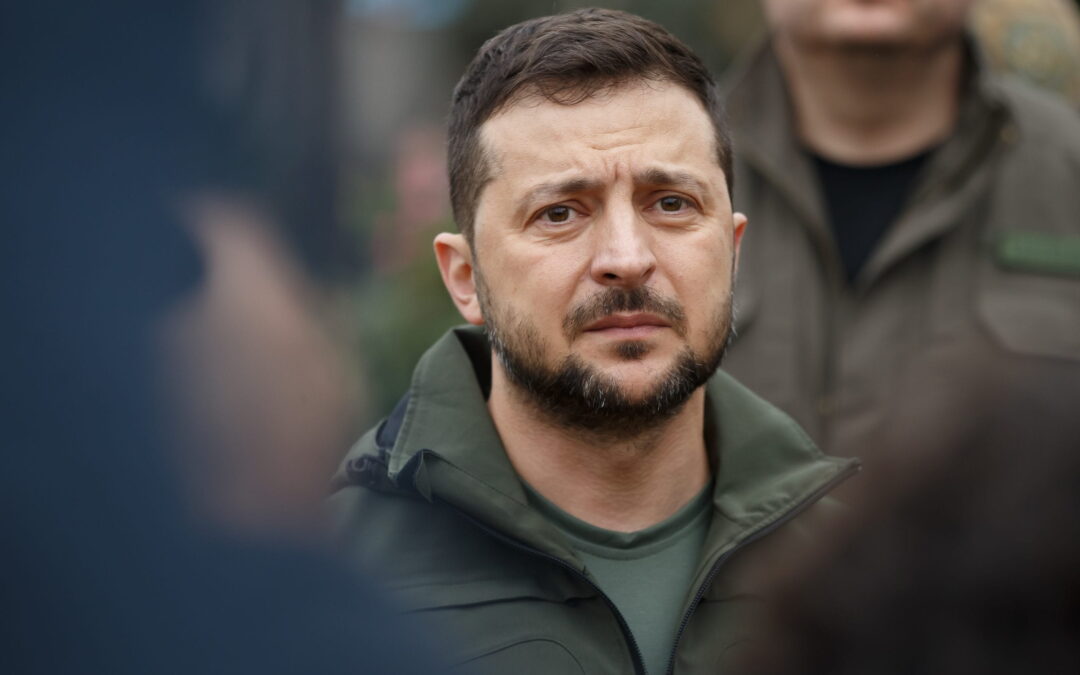
There is now hardly anyone in the world who does not know the name Volodymyr Zelensky, the president of Ukraine. Yet just three weeks ago, few people outside Ukraine knew who he was.
A former comedian, Zelensky rose to fame by starring in a sitcom he created titled Servant of the People, in which he portrayed a young, honest, and reform-minded president fighting corruption. The show captured the imagination of the Ukrainian people and gained overwhelming popularity. Riding this wave of public support, Zelensky and members of the show launched a political party bearing the same name. Zelensky was then elected president by a landslide, becoming the youngest president in Ukrainian history.
However, the leadership he demonstrated as a political newcomer was, frankly, comical. The disappointment and regret felt by the Ukrainian people were profound. As if matters could not get worse, at this moment of leadership vacuum, Vladimir Putin, the embodiment of strong authoritarian leadership, invaded Ukraine with overwhelming military force.
Yet something completely unexpected has happened. At a moment when the fate of the nation hangs by a thread, Zelensky is demonstrating remarkable leadership. Western media have remarked that during this war, Zelensky has transformed “from comedian Charlie Chaplin into wartime hero Winston Churchill.”
In this column, I would like to analyze two outstanding aspects of Zelensky’s leadership and apply them to ourselves as pastors and preachers.
1. Zelensky Is an Exceptional Communicator
The most important element of communication is the connection between the communicator and the audience. Great communicators skillfully employ both verbal and nonverbal elements to create that connection.
Even after broadcasting stations were destroyed by bombing, Zelensky has remained constantly connected with his people through social media platforms such as Facebook and Twitter. If leadership can be defined in one word, it is influence. If we must add another word, it would be communication.
When rumors spread that the president had fled the country after the war began, Zelensky quickly extinguished them through direct communication. He appeared on social media with members of his cabinet, demonstrating that the Ukrainian government was still functioning under his leadership.
Do you want to become an outstanding leader? Then you must develop the ability to communicate complex situations and ideas simply and clearly, using both language and nonverbal expression.
Sharp biblical interpretation and eloquent delivery alone do not make a great preacher. A great preacher must continually connect with the audience. Once the connection is established, the congregation will respond with “Amen” regardless of what the preacher says. But when the connection fails, even the strongest logic and rhetoric echo uselessly into the air.
At the heart of communication lies connection. If there is no connection, communication has not taken place. If there is a connection, words may not even be necessary.
How, then, can a preacher connect with the audience? This is a question every preacher must study as diligently as biblical exegesis. More explanation does not guarantee a connection. In fact, the more concise the message, the greater the likelihood of connection.
Connection occurs not through reason and logic alone, but when emotions are touched, and genuine inspiration is felt. This leads directly to the second defining feature of Zelensky’s leadership.
2. Zelensky Practices Inspirational Leadership
Amid the chaos of war, Zelensky has unified Ukrainians and European leaders through inspiration, while clearly pointing the way forward even under heavy bombardment.
What is leadership? It is the ability to gather scattered hearts and lead them in the same direction. A leader who cannot unite people is not truly a leader. Division is the result of leadership absence.
Before the war, Zelensky’s approval ratings were dismal. Today, they exceed 91 percent. In Ukraine now, there is effectively no ruling party or opposition party—only a nation united under Zelensky’s leadership.
How did he unite the people? Through courage and self-sacrifice, which deeply moved the nation. Courage and sacrifice are not leadership techniques; they are matters of character. Without developing character, leadership cannot be developed. Leaders must become people of character before becoming people of skill.
Inspiration is the most powerful force that moves people to action.
When the United States offered to evacuate him, Zelensky famously replied,
“I don’t need a ride. I need ammunition.”
These words moved the world.
When a Western journalist asked, “You are already a target of Russian snipers. Aren’t you afraid? Are you able to see your family every day?” Zelensky responded:
“I know my family is safe, but I have not seen them at all. Am I afraid? Yes, I am afraid. Who is not afraid of death? But I am the president. In a moment when the survival of the nation is at stake, the president does not have the right to fear death.”
This stirring response stands in stark contrast to the humiliating actions of the Afghan president, who fled the country with his family when the Taliban entered Kabul last August. Zelensky’s courage has filled Ukrainians with confidence, inspiration, and resolve.
Ukrainians will resist the evil embodied by Putin to the very end—because Zelensky has planted courage and inspiration in their hearts, uniting them as one people.
Human beings cannot live by bread alone. Without inspiration, the human soul becomes barren. When a leader inspires followers, wholehearted support follows.
Through words and actions of inspiration, Zelensky has given the Ukrainian people both a reason to fight and the courage to endure. A leader who fulfills his duty while disregarding even his own safety and that of his family embodies servant leadership and inspirational leadership at its finest.
Crisis and Leadership
When we reflect on ministry experiences, they can often be summarized as a series of crises. No pastor enjoys crises. Yet anyone who desires successful ministry must completely change how they view crisis.
“Necessity is the mother of invention.” Desperate crises create leaders. Personal, social, ecclesiastical, and national crises are precisely the environments in which leadership can shine most clearly.
Churchill rose during World War II.
MacArthur, Eisenhower, and Montgomery became five-star generals because of World War II.
Leaders like Reagan and Thatcher emerged from the Cold War crisis.
Lee Iacocca revealed his leadership when Chrysler faced bankruptcy.
Zelensky has risen as a global leader amid the crisis of war.
Leaders need not fear a crisis. Ambitious leaders should almost welcome it. Whether we desire it or not, a crisis will surely come.
John Clements and Steve Albrecht describe leadership this way in The Leadership Challenge:
“Leadership is innovative and challenging… even risky… requiring comfort with uncertainty… prudent risk-taking… tireless work… sometimes breaking rules… empowering others… setting goals… adventurous, skillful, charismatic communicators—these are leaders.”
Today, Zelensky stands at the very center of the national crisis, revealing the full measure of his leadership—like a fish thriving in water.